
When people start comparing community living and independent living, they are rarely looking for definitions. They are trying to picture their day to day life. How much responsibility they will carry. How connected or isolated they might feel. How their living environment will support them over time.
At Prosper Communities, this comparison comes up often. Some residents arrive after years of fully independent living. Others explore both options before deciding where they feel most comfortable. What becomes clear is that the difference between these two models is not about labels. It is about how people actually live.
This guide is meant to help you understand those differences clearly, without pushing you toward a particular choice.
Independent Living Explained Through Real Life Scenarios
Independent living is often described as freedom, and in many ways that is accurate. It offers full control over space, schedule, and decisions. At the same time, it also places full responsibility on the individual.
What Independent Living Looks Like Day to Day
In independent living, everything is self managed. Housing, maintenance, errands, social life, and problem solving all sit with the individual. There is no built in structure beyond what a person creates for themselves.
For some, this feels empowering. Daily routines are shaped entirely by personal preference. There is no shared environment to navigate and no expectations beyond one’s own.
For others, this can become tiring over time. Everyday tasks add up. Social interaction requires planning rather than happening naturally. When circumstances change, the structure does not adapt unless the individual does the work to change it.
Who Thrives in Independent Living
Independent living often works best for people who strongly value autonomy and are comfortable handling everything on their own. This includes professionals who enjoy self direction, individuals in transitional life stages, and people who prefer solitude over shared environments.
The key factor is not age, but comfort with responsibility and isolation. Independent living suits those who feel energized by managing their own environment.
What Community Living Means in Practice
Community living is sometimes misunderstood as a loss of independence. In reality, it is a different way of organizing independence.
Private Living With Built In Community
Modern community living combines private residences with shared environments. Residents have their own homes, their own routines, and their own boundaries. What changes is the surrounding structure.
Instead of isolation being the default, connection becomes available. Shared spaces, walkable layouts, and familiar faces create an environment where interaction happens naturally rather than through effort.
How Community Living Works at Prosper Communities
In practice, community living is shaped by design and management decisions. At Prosper Communities, residential environments are planned to balance privacy with accessibility. Shared spaces exist to support daily life, not to enforce participation.
Residents choose how involved they want to be. Some engage frequently. Others prefer quiet routines. The environment supports both without friction.
This flexibility is what often draws people who want independence without feeling disconnected.
Key Differences Between Community Living and Independent Living
Understanding the differences between these two options requires looking beyond surface features.
Social Interaction and Isolation
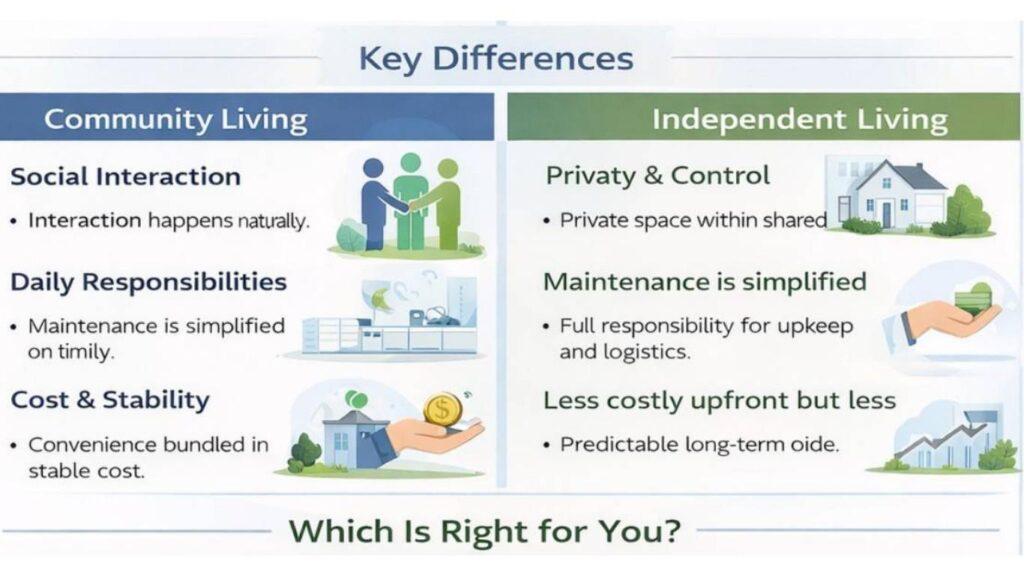
Independent living depends on self initiated social activity. Community living reduces isolation through proximity and familiarity. Interaction is optional, but the environment does not separate people by default.
Privacy and Control
Both models offer privacy. Independent living offers control through separation. Community living offers control through choice within a shared environment. The difference is not privacy itself, but how it is maintained.
Daily Responsibilities and Support
In independent living, all responsibilities are personal. In community living, many logistical aspects are simplified or shared. This does not remove independence, but it does reduce daily friction.
Lifestyle Stability Over Time
Needs change. What feels manageable today may feel heavy later. Community living environments are designed to support long term stability, while independent living requires continuous personal adjustment.
Cost Comparison: Why Price Alone Is the Wrong Metric
Cost is often the first comparison point, but it is rarely the most accurate one.
Independent living may appear less expensive at first. However, hidden costs add up over time. Maintenance, transportation, time spent managing issues, and social isolation all carry value beyond money.
Community living often bundles convenience, accessibility, and stability. While the structure may look different on paper, the lived cost can be more predictable and less demanding.
The right comparison is not which option is cheaper, but which one aligns better with how you want to spend your time and energy.
Community Living vs Assisted Living: A Necessary Clarification
These terms are often confused, but they describe very different models.
Community living is not assisted living. It does not provide medical care or daily assistance. It is designed for individuals who are independent but value connection and supportive environments.
Independent living is also not the same as nursing care or assisted living. It simply describes housing without built in support structures.
Understanding these distinctions helps prevent choosing an option that does not match actual needs.
Who Community Living Is Best For
Based on resident patterns, community living often appeals to people who want balance.
Families appreciate environments where familiarity and safety are part of daily life. Professionals value reduced friction and a sense of place. Older adults often enjoy maintaining independence while having connections nearby. People relocating to a new city find it easier to settle into an environment that supports interaction naturally.
The common thread is not age, but a preference for environments that support both independence and belonging.

Who Independent Living Is Best For
Independent living remains a strong choice for those who value solitude and full control. People in short term living phases, individuals comfortable managing everything alone, and those who prefer minimal interaction may find this model more suitable.
There is no disadvantage in choosing independence when it aligns with personal preference.
How to Decide Between Community Living and Independent Living
The decision comes down to how you want your environment to support you.
Ask yourself how you feel about shared spaces. Consider how much responsibility you want to carry alone. Think about how you handle change and whether connection energizes or drains you.
For many readers, revisiting is community living right for you helps clarify personal fit, while understanding what community living really means removes assumptions from the decision.
Closing Thoughts
Community living and independent living are not competing lifestyles. They are different frameworks for organizing daily life.
The right choice is the one that aligns with your routines, preferences, and long term comfort. Taking the time to understand the differences leads to decisions that feel grounded rather than rushed.
When living environments support who you are, everyday life becomes easier to manage and more satisfying to experience.