
The phrase “community living” is used often, but it is not always explained clearly. In housing, lifestyle discussions, and public policy, the term can refer to different things depending on context. That lack of clarity is what causes confusion.
Community living is not a trend, a marketing label, or a single type of housing. It is a way of organizing residential environments so that people live independently while remaining connected to those around them through intentional design.
Understanding what community living actually means requires looking at how it is structured, how it functions day to day, and how it differs from more traditional housing models.
What the Term “Community Living” Refers To
At its most basic level, community living refers to residential environments that are planned to support interaction, shared use of space, and a sense of belonging among residents.
In modern contexts, community living does not mean shared ownership, shared housing, or communal lifestyles. Residents typically have their own private homes or living units. The defining difference lies in how those homes relate to one another and to shared spaces within the community.
The term is also used by public institutions such as the Administration for Community Living to describe living arrangements that support independence while ensuring access to connection and support. While those definitions are often applied in social or policy settings, the underlying principle aligns with residential community living as well.
In simple terms, community living describes environments where people are not separated by default, but connected by design.
Key Elements That Define Community Living
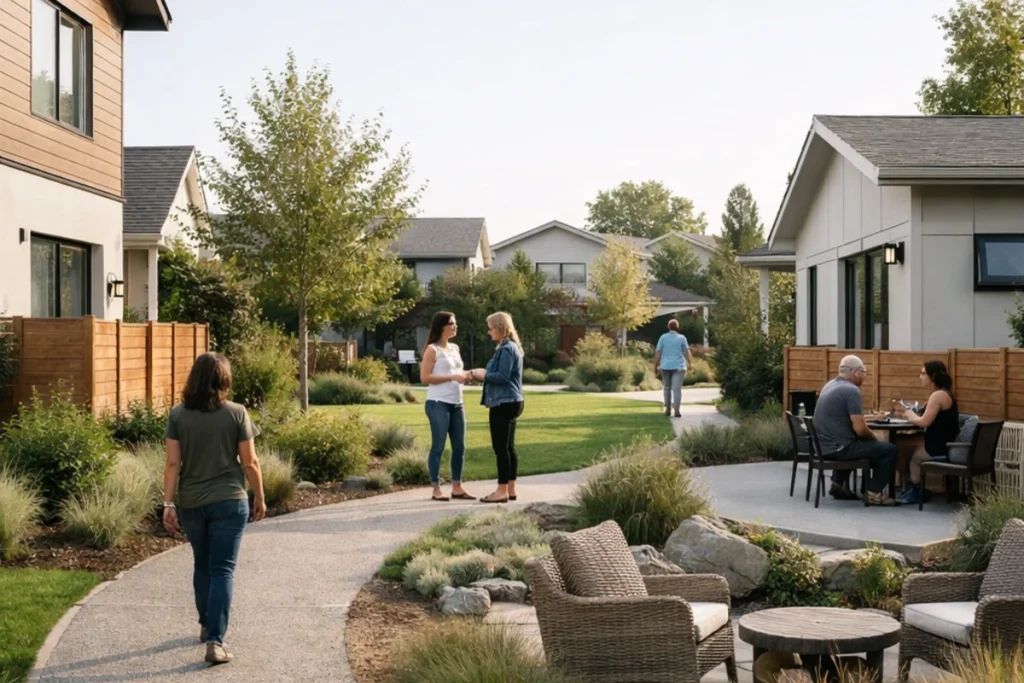
Community living is not defined by aesthetics or amenities alone. It is defined by a combination of structural elements that shape how people experience their surroundings.
Private living spaces
Residents have their own homes or personal spaces. Privacy and independence remain central to the model.
Common areas such as outdoor spaces, pathways, or facilities are part of the design. These spaces are intended for everyday use, not just scheduled activities.
Intentional layout and planning
Homes are arranged to encourage walkability, visibility, and natural movement through the community. The environment supports interaction without requiring it.
Community living does not depend on participation. Interaction is available rather than expected, allowing residents to engage at their own comfort level.
Together, these elements distinguish community living from housing that is designed primarily around separation and individual containment.
Different Forms of Community Living
Community living does not follow a single model. It appears in different forms depending on location, population, and purpose.
Some communities are residential neighborhoods designed around walkable layouts and shared green spaces. Others are mixed use developments that combine housing with everyday services within the same environment.
There are also age inclusive communities where people at different life stages live within the same framework, as well as communities designed to support specific needs while preserving independence.
What connects these forms is not uniformity, but intention. Each model applies the same core principles in ways that fit its context.
What Community Living Is Not
Because the term is often misunderstood, it is important to clarify what community living does not mean.
It does not mean communal housing where residents share kitchens or living rooms unless explicitly designed that way.
It does not mean loss of privacy or personal boundaries. Private space remains a foundational element.
It does not mean constant social engagement. Residents are not expected to participate or interact beyond their comfort level.
It does not mean a one size fits all lifestyle. Community living environments are frameworks, not rules.
Distinguishing these points helps separate modern community living from outdated assumptions or unrelated models.
How Community Living Differs From Traditional Housing
The primary difference between community living and traditional housing lies in structure rather than function.
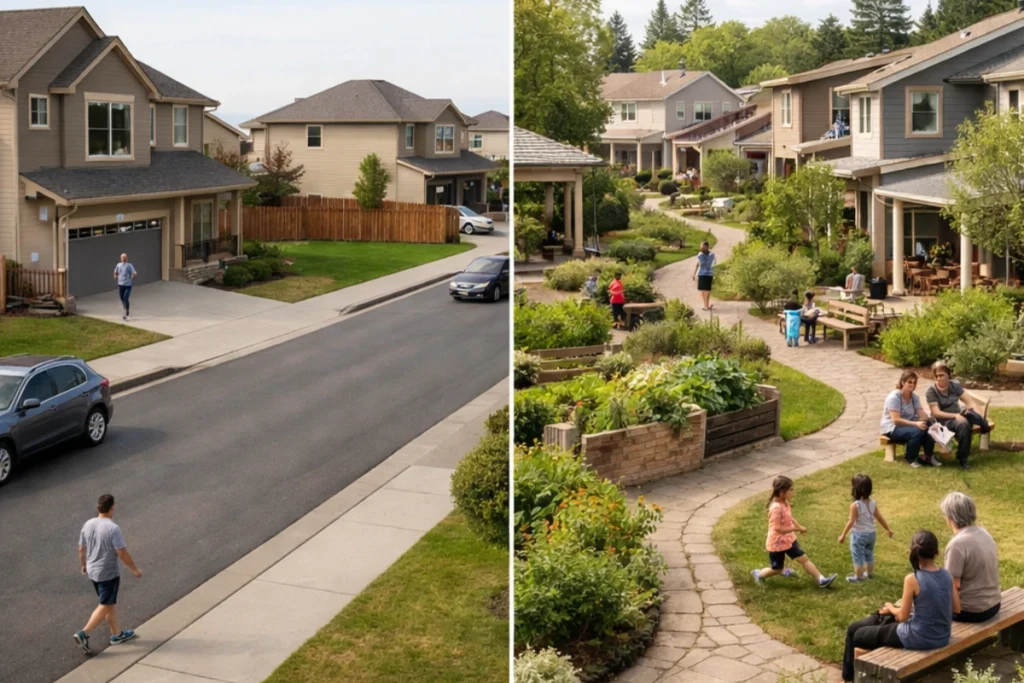
Traditional housing is often designed around individual units with limited consideration for how residents relate to one another. Streets and spaces prioritize separation and efficiency rather than connection.
Community living environments are planned with shared experience in mind. Movement, visibility, and access to common spaces are integrated into the layout. Interaction is not imposed, but isolation is not built in.
Neither approach is inherently superior. They serve different preferences and priorities. The distinction becomes important when people consider how they want their daily environment to support their way of living. Choosing a community lifestyle?
Why the Term Is Used More Today
The growing use of the term “community living” reflects broader changes in how people think about housing and daily life.
As routines become more fragmented and traditional neighborhood structures change, people are paying closer attention to how their living environment affects connection, convenience, and independence.
Community living offers a framework for discussing those considerations without prescribing a specific lifestyle. It provides language for environments that are designed around people rather than isolation.
Conclusion
Community living is best understood as a design approach rather than a lifestyle mandate. It describes residential environments that balance private living with shared space through intentional planning.
By focusing on structure, layout, and optional interaction, community living offers an alternative to housing models built around separation. Understanding what it is helps people evaluate whether this type of environment aligns with their needs and preferences.
For readers interested in how these environments translate into practical and lifestyle outcomes, the discussion of the benefits of community living builds naturally from this foundation.